French Macarons
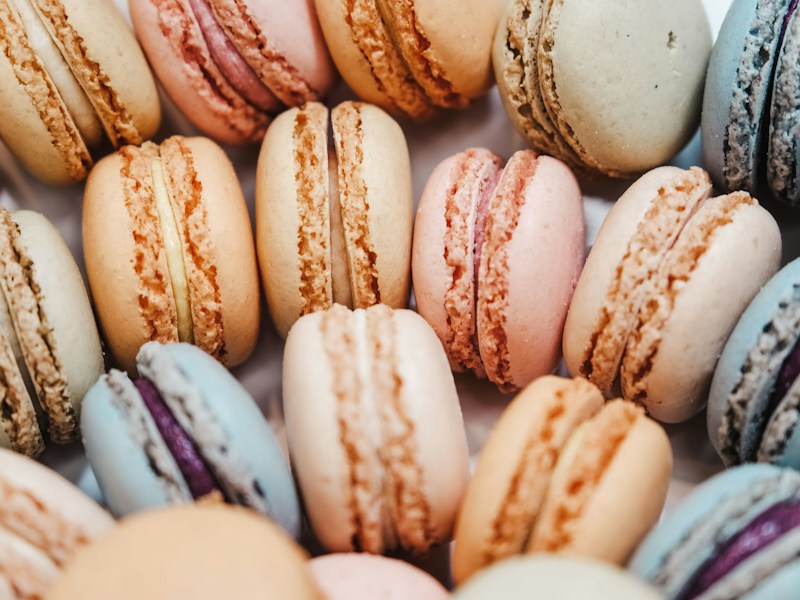
Delicate French macarons with smooth tops, ruffled feet, and a luscious buttercream filling. These elegant almond meringue cookies require patience and precision but reward you with a truly impressive confection.
Desserts · Prep 45 min · Cook 18 min · Serves 24 · Hard · By Tina · Published
Ingredients
- 1.75 cups almond flour, finely ground
- 1.5 cups powdered sugar
- 3 large egg whites, aged at room temp 24 hrs
- 0.25 cup granulated sugar
- 0.25 tsp cream of tartar
- 1 tsp vanilla extract
- 1 drop gel food coloring, optional
- 0.5 cup butter, softened, for filling
- 1.5 cups powdered sugar, for filling
- 2 tbsp heavy cream, for filling
- 0.5 tsp vanilla extract, for filling
The Mount Everest of Baking (and You Can Totally Summit It)
Let me be honest with you: French macarons are the hardest thing I have ever baked. They are finicky, temperamental, and will absolutely humble you the first time you try them. But when you pull a tray of perfect little domes with ruffled feet out of the oven, the feeling of accomplishment is unlike anything else in the kitchen. And the taste, that delicate crunch that gives way to a chewy, almond-scented interior, is worth every frustrating failed batch that came before.
I am sharing everything I have learned through many, many attempts so you can skip the tears and get straight to the triumph.
The Dry Mix
Sift 1.75 cups of finely ground almond flour and 1.5 cups of powdered sugar together through a fine-mesh sieve. Do it twice if needed. I mean it. Any lumps that make it through will show up as bumps on your macaron tops, and we did not come this far to have bumpy macarons. Discard any large almond pieces that refuse to pass through.
Whipping the Meringue
Place 3 room-temperature egg whites in a spotlessly clean, dry mixing bowl. Any trace of grease or yolk will prevent them from whipping properly. Beat on medium speed until foamy, then add a quarter teaspoon of cream of tartar. Gradually add a quarter cup of granulated sugar, one tablespoon at a time, while increasing the speed to high.
Beat until you reach stiff, glossy peaks. The meringue should hold its shape firmly when you lift the whisk. It should look like shaving cream and feel smooth, not gritty, when you rub a bit between your fingers. Add vanilla extract and gel food coloring at this stage if desired.
The Macaronage (a.k.a. the Make-or-Break Step)
Add all the sifted dry ingredients to the meringue at once. Using a large spatula, fold by cutting down the center and sweeping around the edge of the bowl. You are deliberately deflating the meringue, and that is terrifying but correct.
The batter is ready when it flows like thick lava, falling off the spatula in a ribbon that slowly merges back into itself within about 10 seconds. Under-mixing gives you lumpy tops. Over-mixing makes flat shells. Count your folds if it helps. It usually takes me about 50 to 60 folds.
Piping and Resting
Fit a piping bag with a round tip and fill with batter. Pipe 1.5-inch rounds onto parchment-lined baking sheets, holding the bag straight up. Leave an inch between each one. Firmly tap the baking sheet on the counter 3 to 4 times to release air bubbles. Pop any visible surface bubbles with a toothpick.
Let the piped macarons rest at room temperature for 30 to 60 minutes until they form a dry skin. Touch one lightly. If no batter sticks to your finger, they are ready. This skin is what creates those beautiful ruffled feet during baking.
Baking
Preheat your oven to 150°C/300°F. Bake one tray at a time for 16 to 18 minutes. The macarons are done when they feel firm on top and peel cleanly off the parchment. Let them cool completely before attempting to remove them.
Match the shells by size, pipe buttercream or filling onto one, and sandwich with its partner. For the absolute best texture and flavor, refrigerate the assembled macarons for 24 hours before serving. This maturation step softens the shells slightly and creates that perfect chewy bite.
Tina's Tips
- Age your egg whites at room temperature for 24 hours. Separate them the day before and leave them covered on the counter. Aged whites whip up stronger and more stable.
- Use gel food coloring, never liquid. Liquid coloring adds water to the batter, which throws off the ratio. Gel is concentrated and does not change the consistency.
- Invest in a kitchen scale. Macaron baking is where precision actually matters. A few grams off in any direction can mean the difference between perfect and flat.
- Do not open the oven door during baking. The temperature shock can cause the shells to crack or collapse. Use the oven light to check progress.
- If your first batch fails, do not give up. Literally everyone fails macarons the first time. Adjust and try again. The learning curve is steep but the payoff is incredible.
More desserts recipes
- Fudge Brownie with coconut pistachio (beginner · 30 min · serves 9)
Rich. Bold. Beautiful. Welcome to the new SugarSpiceLab signature bar — where tropical soul meets luxury. - Fudgy Brownies (Easy · 25 min · serves 16)
Intensely chocolatey brownies with a crackly top and a dense, fudgy interior that melts on your tongue. These… - Gulab Jamun (Hard · 30 min · serves 15)
Golden. Syrup-soaked. Impossibly decadent. India’s most iconic dessert — soft milk dumplings swimming in… - Lemon Posset with Shortbread (Easy · 5 min · serves 4)
Three ingredients, zero cooking skills, one unbelievably silky lemon dessert. This is my secret weapon for… - Mango Sticky Rice (Easy · 25 min · serves 4)
Sweet, creamy, and tropically perfect. The dessert that makes every Thai meal complete. Warm coconut sticky… - Mochi (Japanese Rice Cakes) (Medium · 5 min · serves 12)
Soft. Chewy. Utterly delightful. Sweet Japanese rice cakes filled with red bean paste — the most satisfying…